




Login
Login
Freya is much more than the goddess of love. Discover who she really is, which runes form her name and how to carry her with you in handcrafted Aragonese olive wood pieces from Paracuellos de la Ribera.
There are gods that inspire fear. And there are gods that inspire desire, beauty and power. Freya is one of the latter — though those who know her well know she also inspires respect.
I am Gemma Anjana, runic artisan in Paracuellos de la Ribera, Calatayud region. When I decided to create a piece dedicated to Freya, I didn't just want to engrave a pretty name on wood. I wanted to understand who this goddess really was, what she represented, and which runes named her. This article is the result of that process.
Freya is one of the most complex and fascinating deities in the Norse pantheon. She belongs to the Vanir — one of the two families of gods in Norse mythology, associated with fertility, nature and magic — as opposed to the Aesir, the group to which Odin belongs.
She is the goddess of love, beauty, fertility and prosperity. But reducing her to that would be scratching the surface. Freya is also the great mistress of war — it is said that whenever there is a battle, she has the right to choose half of the fallen before Odin, whom she takes to her hall Fólkvangr. And above all, Freya is the great mistress of seiðr.
The seiðr was the most powerful and mysterious magical art of the Nordic tradition. It was not brute-force magic — it was a magic of knowledge, perception, and the ability to see the threads of fate and, on occasion, alter them.
It was practised in altered states of consciousness, through song, trance and ritual. Its practitioners could see the future, communicate with the dead, influence the fate of people and protect or curse. It was profoundly feminine magic in its origin — although Odin also practised it, something that in Nordic culture was considered transgressive.
It was Freya who taught seiðr to Odin. That says a great deal about her power.
The colour of seiðr, the colour of that magic that exists between worlds, is purple — the colour of the threshold, of what lies between the visible and the invisible, between the human and the divine.
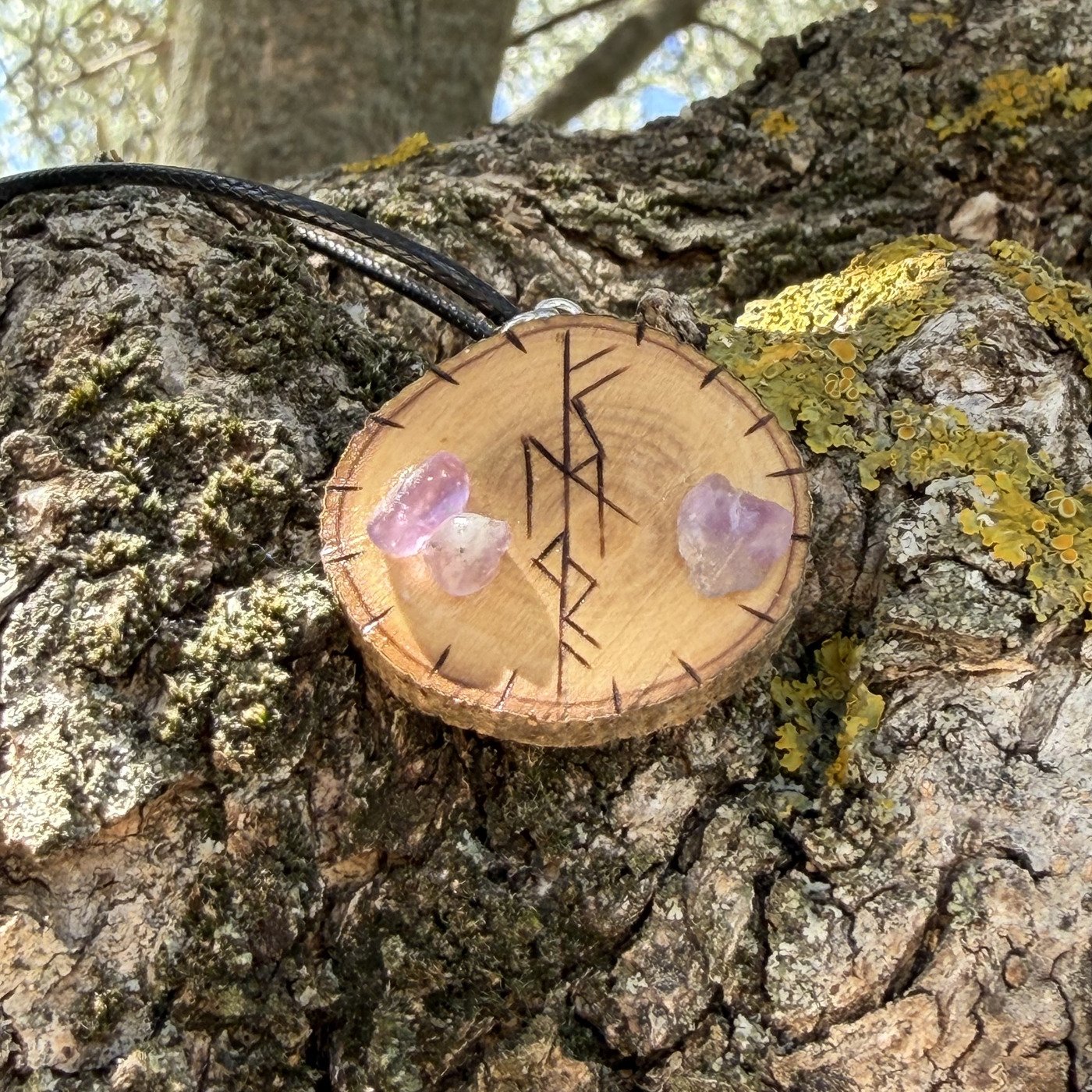
Arte Rúnico's Freya pieces have her name engraved in the Elder Futhark runic alphabet. Each rune has its own meaning, and together they tell the story of the goddess.
The five runes that form Freya's name are:
Five runes. Five dimensions of Freya. Every time you look at the piece, you are reading her name in the language of the gods.
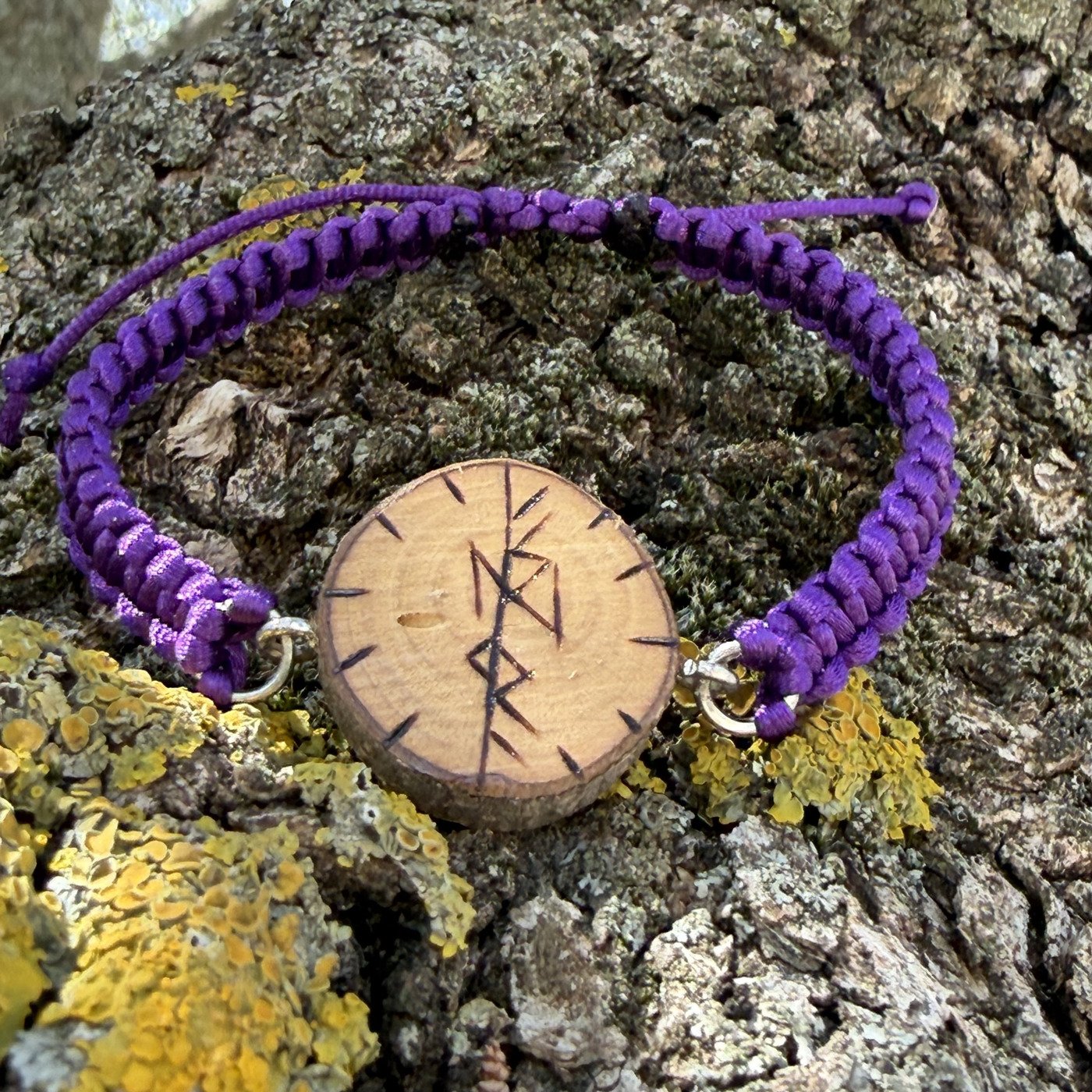
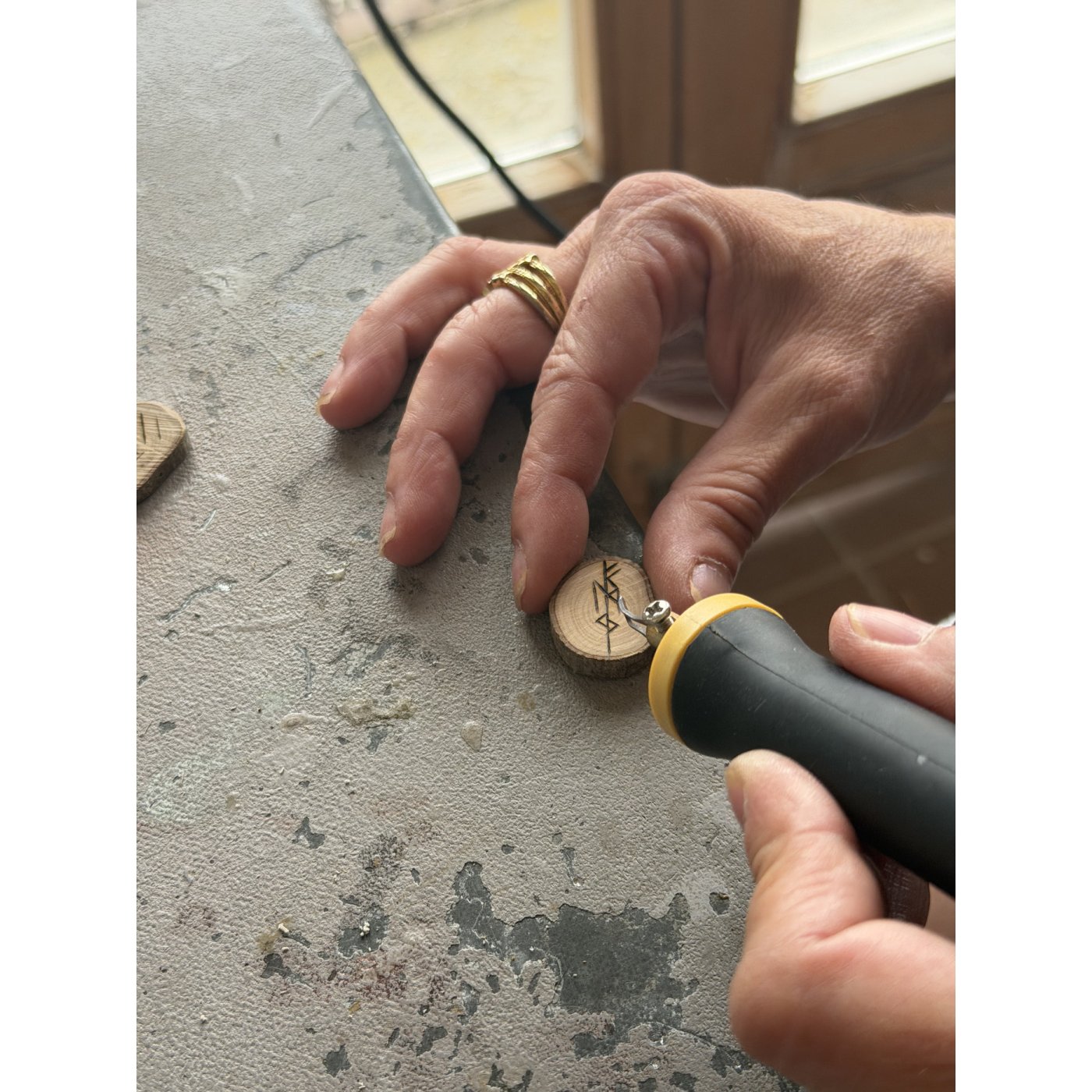
All Freya pieces are hand-carved in olive wood from Paracuellos de la Ribera, pyrographed with the five runes of her name in vertical.
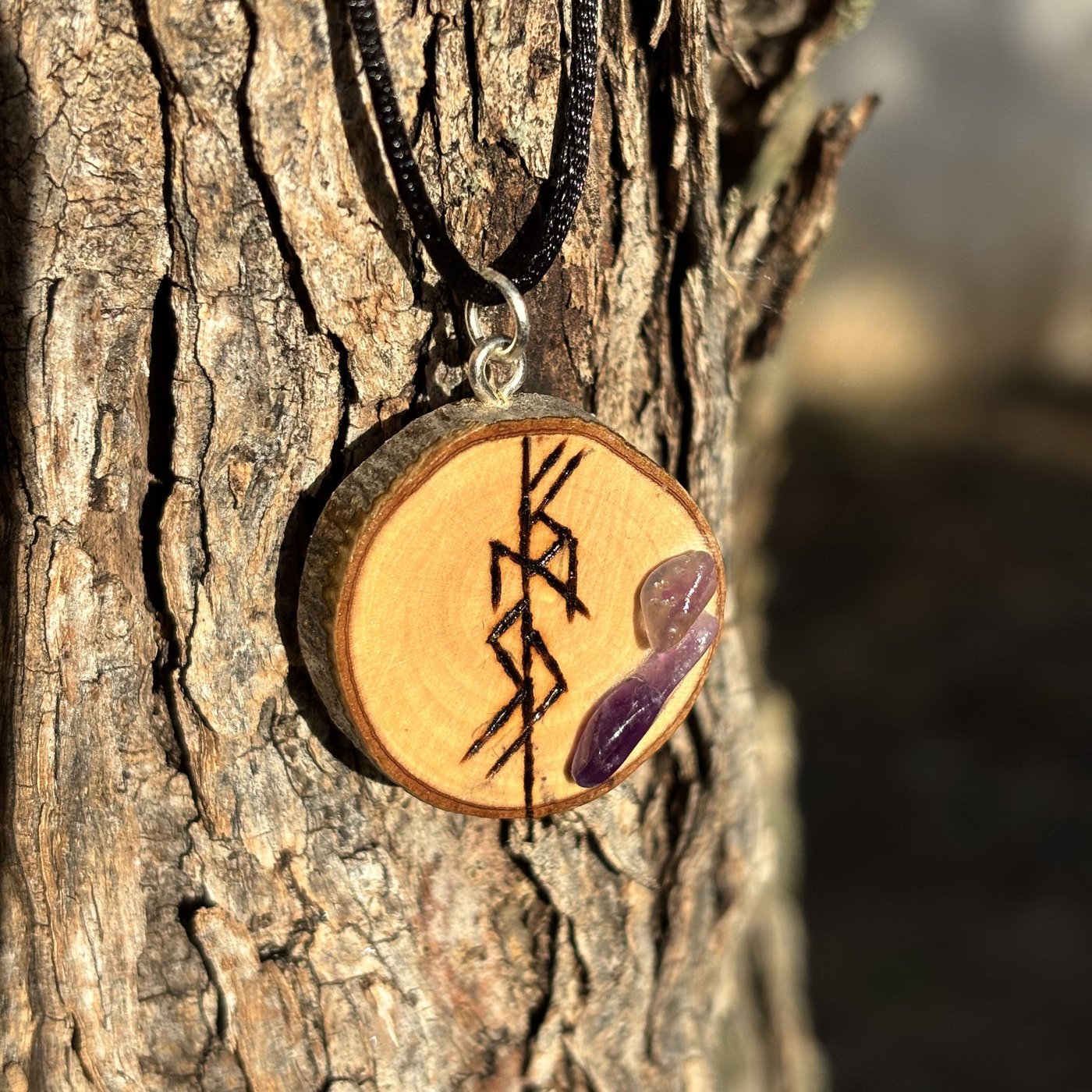
Freya pendant with amethysts — A 2.8 cm diameter olive wood disc hand-pyrographed with the five runes of Freya's name. With amethysts, a stone long associated with intuition, spiritual protection and connection with the sacred. An amulet to wear over the heart.
Freya bracelet with purple macramé — A 1.9 cm olive wood disc with the runes engraved vertically, anchored to a hand-braided purple macramé. Adjustable between 5 and 7.5 cm. The purple is not decoration — it is the colour of the threshold, of the magic that transforms, of the seiðr that Freya taught Odin.
These and other Freya pieces are part of the love talismans collection at Arte Rúnico.
There is something I find deeply coherent in creating Freya pieces here, in this corner of the Calatayud region. Freya is the goddess of fertility, nature and cycles — and the pieces that bear her name are born from the olive trees of an Aragonese village that has been cultivating that same land for centuries.
The wood I use comes from the suckers I collect in the olive groves of Paracuellos de la Ribera, trees that have been growing in silence for decades while the village, like so many in emptied Spain, fights against depopulation. Turning that wood into a talisman of love and prosperity has a meaning that goes beyond craftsmanship. It is giving life back to something that could have stayed on the ground.
That is also Freya.
A Freya talisman is not just a pretty piece of jewellery. It is an intention. It is choosing to carry with you the energy of a goddess who represents love in all its forms — romantic love, but also self-love, abundance, creativity and feminine power in its fullest expression.
It is also a connection with a spiritual tradition of more than a thousand years, engraved in the wood of an olive tree that has been growing for decades in the fields of Paracuellos de la Ribera.
See all Arte Rúnico love talismans →
Keep reading: Arte Rúnico Gemma Anjana — a heartfelt project from Paracuellos de la Ribera →
